
Viking Runes
The Vikings had their own system of writing. Instead of using the alphabet we use today, they often wrote with symbols called runes. These symbols can still be found carved into stones, jewellery and everyday objects more than 1,000 years later.
If you’ve read Cressida Cowell’s How to Train Your Dragon books, you may already have come across runes. Runes were used to write Old Norse, the language spoken by the Vikings. Hiccup Horrendous Haddock’s adventures were originally written in Norse before being translated into modern English. But what can runes tell us about the Vikings, and how might they help us understand the lost language of Dragonese?
What Are Runes?
Runes were the main writing system used by Vikings. Just as we use an alphabet today, Vikings used a set of symbols called runes to write messages, carve inscriptions and record important information. As Christianity spread through Scandinavia, some Vikings also learned to read and write using the Latin alphabet. However, runes remained the writing system most closely associated with Viking culture.
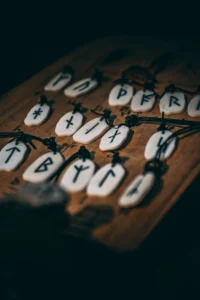
The runic alphabet used during the Viking Age is known as the Younger Futhark. The name comes from the first six runes: F, U, TH, A, R and K.
Younger Futhark was made up of just 16 runes, far fewer than the 26 letters we use in English today. Because there were fewer symbols, a single rune often had to represent several different sounds. This worked well for Viking languages, but it can sometimes make translating runic inscriptions more challenging for modern historians.
You may have noticed the word Younger in the name. That suggests there must have been an older version—and there was.
Before the Viking Age, people used a runic alphabet known as the Elder Futhark. This earlier version contained more characters and was used by Germanic-speaking peoples across northern Europe. By around AD 700, however, it had largely been replaced by the Younger Futhark used by the Vikings.
Although runes were used for writing, we do not know exactly how many people could read and write them. Most surviving examples are found on objects such as jewellery, wooden sticks, tools and, most famously, runestones.
Runestones
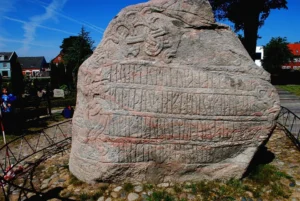
Runestones are large stones carved with runic inscriptions. Most have been found in Scandinavia, and many still stand in the places where they were first erected more than 1,000 years ago.
Creating a runestone required both skill and effort. Large stones had to be transported and raised, while the inscriptions had to be carefully carved into the surface. Because of this, many archaeologists believe runestones were often commissioned by wealthy families.
Many runestones were created to remember relatives who had died. Others recorded journeys, celebrated achievements or marked important events.
Unlike a coin, a runestone rarely comes with an exact date. Instead, archaeologists look for clues that help them estimate when it was made. These clues include:
- The type of runic alphabet used.
- The style of decoration.
- The language and spelling of the inscription.
- References to known people or historical events.
No single clue can provide an exact date. However, when archaeologists compare lots of stones, patterns begin to emerge.
One of the most famous examples is the Jelling Stone in Denmark. It was raised by King Harald Bluetooth and records his rule over Denmark and Norway, as well as the conversion of the Danes to Christianity. Because these events took place during Harald’s reign, historians can date the stone to around the 960s, even if they cannot identify the exact year it was carved.
Were Runes Magic?
Runes may not have had magical powers, but many Vikings believed they were special.
Part of this idea comes from stories about the god Odin. In later Norse myths, Odin is said to have discovered the secrets of the runes. However, these stories were written down centuries after the Viking Age had ended.
Other Viking stories also suggest that some people believed runes could be used for protection, healing or good luck. In Egil’s Saga, for example, the hero Egil Skallagrímsson carves runes onto a drinking horn to test it for poison and later uses runes to help cure a sick girl.
The word rune originally meant “secret” or “mystery”. This may help explain why some people came to think of runes as magical.
For much of history, the ability to read and write was unusual. Someone who could understand runes might have seemed very knowledgeable or even mysterious. So, if you could read and write 1,000 years ago, you may well have been one of the most impressive people in the village!
Dragonese
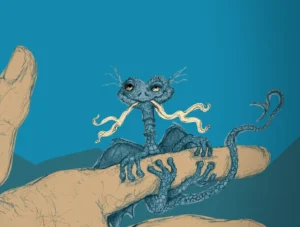
Dragonese is a lost language, but thanks to Hiccup’s writings, a few clues have survived. It was used to speak with dragons, but not many Vikings from the Barbaric Archipelago had the skill (or the patience) to learn it!
So what does this have to do with runes?
Hiccup recorded Dragonese using runes. That means dragonologists first have to read the runic writing before they can begin translating the language itself.
This is similar to the way historians study ancient languages. Sometimes a language stops being spoken, but written records survive. By carefully studying those records, experts can begin to understand how the language worked.
Just as archaeologists use runes to learn about Old Norse, we use Hiccup’s notes to help decipher Dragonese.
Languages also change over time. Latin, for example, eventually developed into languages such as French, Spanish, Italian, Portuguese and Romanian. Although nobody grows up speaking Latin today, written records help us understand it. Experts use a similar process when trying to unlock the secrets of Dragonese.
If you’ve read some of the How to Train Your Dragon books, you may even have come across pages from Hiccup’s Dragonese dictionary. Those clues help us piece together how the language worked, one word at a time.
What Can Runes Tell Us?
Runes help us understand how Vikings communicated, recorded important events and remembered the people around them. Today, they still provide valuable clues about life in the Viking Age.
They also remind us how difficult it can be to understand a lost language. Whether archaeologists are studying ancient runestones or dragonologists are trying to translate Dragonese, every word can reveal a new piece of the story.
Before you go, here is one useful Dragonese phrase to remember. If you ever meet a dragon, simply say:
“Howdeedoodeethere!“
Just make sure you say it loudly enough for the dragon to hear you – unless they have sharp teeth and look very hungry, then maybe it’s best to keep quiet!